Raspberry Pi - a daily driver?
Since the US incursion onto Greenland earlier this year and their decisive turn away from the liberal-democratic world, I have resolved to divest myself of as much US Big Tech as possible. This is no simple task - unlike the early days of the computer revolution where you had hundreds of companies working on software and users had a wide variety of choice, we now have all our software infrastructure more-or-less centralised at data centres; all owned by a handful of (predominantly American and pro-authoritarian) companies.
The good news is that it's easy to swap software products; if you don't like Microsoft Office, there are lots of alternatives that are made elsewhere. I now use Softmaker Office NX for productivity. It works well for that purpose and comes from a German software company. Spotify commits all sorts of sins but they are nonetheless a Swedish company; no change there. You can replace Gmail with Proton Mail hailing from Switzerland; they have a decent AI assistant, cloud storage, and VPN services available too. Google Search can be substituted with Mojeek or GOOD Search, though the latter is a paid-for search service. These solutions work well and most importantly: they keep my money out of US tech.
Some things are much more difficult to avoid - hardware is a good example. I am yet to find a good replacement for my iPhone and this will be the last thing I change. I also had trouble finding an European-made computer until quite recently, when I came across the new Raspberry Pi 500+.
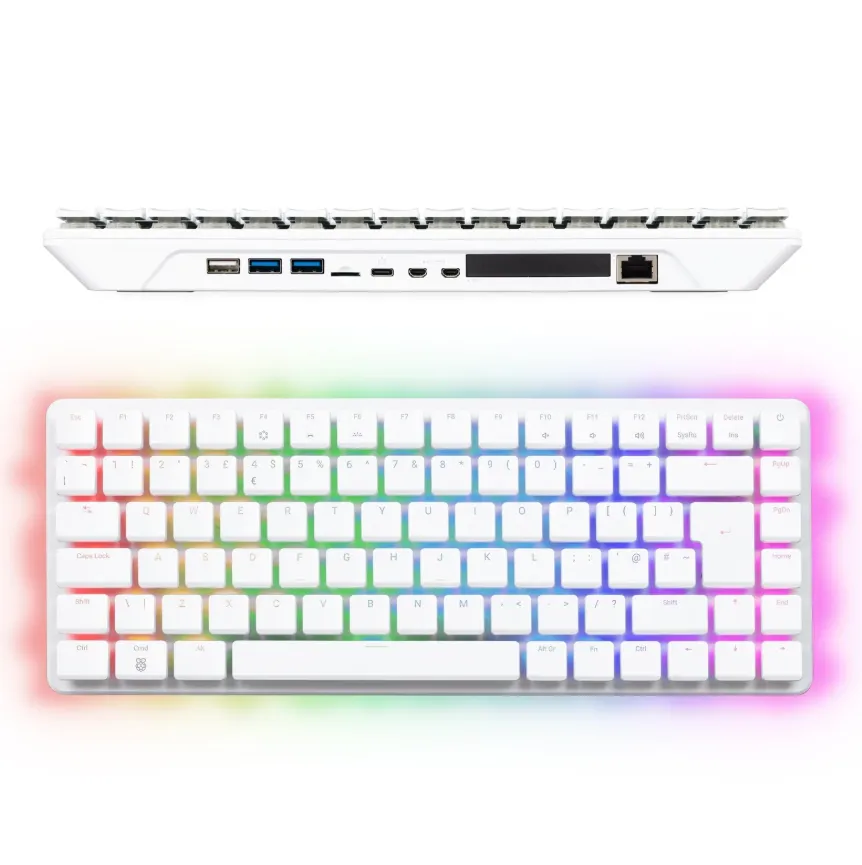
This is quite a curious device! It's an all-in-one keyboard computer reminiscent of the 1980's but with up-to-date tech inside. What's interesting about the AIO format is how it's making people like me rethink what a Pi could actually be useful for. They are still best suited to small projects and IoT applications but there's an emerging case for the Pi as a platform distinct from X86 and Apple Silicon. Three major things in its favour, all of which get more relevant with every passing year; the latest models have lots of computing power compared to predecessors, the software support for Pi is outstanding, and the Pi is generally considered a leader in the field of power efficiency.
Now let's look at the 500+ as a prospect. The Pi 500+ gives you ultra-low power consumption, 16GB of RAM, and 256GB of SSD storage -- all for under £400. There are some curious caveats; that price does not include a monitor, there's no headphone jack, and there's no upgrading possible (though you can extend the computer's functions by adding HATs).
So, I would say the 500+ is a cheap and cheerful high-end-low-end PC with buckets of RAM and storage, made in the UK, increasingly capable of daily-driver duties, all while using a minimal amount of electricity.
All great, but I'm undecided if I'm prepared to spend the money on it. My Surface Go 2 laptop works okay and comes with the same RAM/disk spec, but there's still no upgrade path and it's increasingly laggy. I'm really only looking at the 500+ because it's a tasteful alternative to the Windows & Mac world, and I'm only trying to avoid them because I am boycotting those companies as much as I can (that is, it's not just a technical decision; it is rather a political one too).